


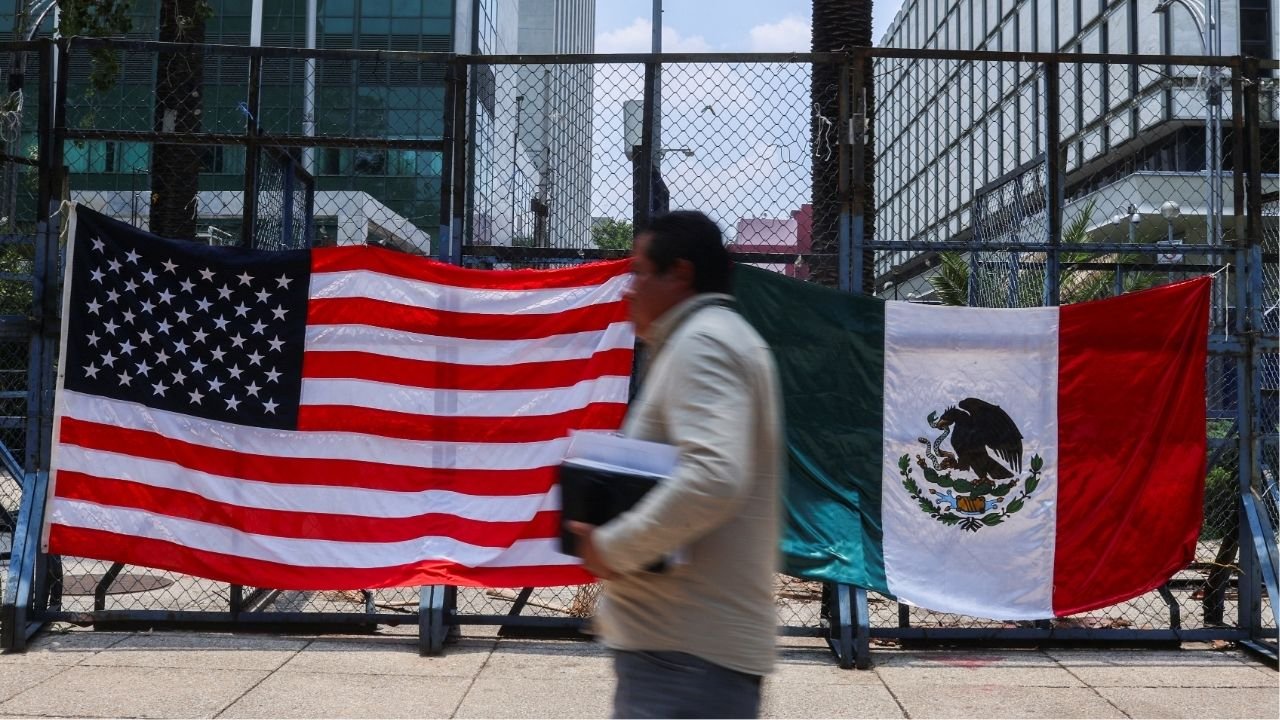
The U.S. government has revoked visas for more than 50 Mexican politicians and officials, marking a sharp escalation in the Trump administration’s campaign against drug cartels and their suspected political allies, according to multiple Mexican officials who spoke with Reuters.
While a few individual cases have been publicized, reporting indicates the visa cancellations are far more widespread — and unprecedented in scope.
A New Diplomatic Pressure Tactic
Former U.S. ambassadors say previous administrations occasionally used visa revocations in criminal or corruption cases, but not at this scale. They view the move as a sign of President Donald Trump’s willingness to use visa authority as a foreign-policy tool.
“The Trump administration is finding new ways to exert more pressure on Mexico,” said Tony Wayne, U.S. ambassador to Mexico from 2011 to 2015.
The decision has quietly unsettled Mexico’s political class — many of whom routinely travel to the U.S. — and may further strain relations between the two countries amid sensitive trade and security talks.
Targeting Mexico’s Political Elite
Officials say most of the visa revocations involve members of President Claudia Sheinbaum’s ruling Morena party, though politicians from other parties were also affected. Only a handful have acknowledged the cancellations publicly, including Baja California Governor Marina del Pilar Ávila, who has denied any links to organized crime.
A senior U.S. State Department official confirmed that visas “may be revoked at any time” for activities “contrary to America’s national interest.” The department is not required to provide explanations to those affected.
The lack of transparency has fueled speculation that those who lost visas may be under investigation, though U.S. officials have not confirmed this.
“The likelihood is that you won’t know whether or not the U.S. is investigating — potentially for years,” said Roberta Jacobson, former U.S. ambassador to Mexico.
A Regional Pattern
The aggressive approach has also reached beyond Mexico.
- In Colombia, Washington revoked President Gustavo Petro’s visa after he spoke at a pro-Palestinian rally and criticized U.S. military orders.
- In Brazil, over 20 judges and officials have lost visas.
- In Costa Rica, even former president and Nobel Peace laureate Oscar Arias was stripped of his visa without explanation.
Christopher Landau, the former U.S. ambassador to Mexico who now serves as a senior State Department official, has publicly called himself “El Quitavisas” — “The Visa Snatcher” — reflecting his role in the policy.
Policy Impact and Diplomatic Risks
Analysts say the sweeping revocations reflect a new front in Washington’s drug war, connecting anti-cartel strategy to visa status under expanded intelligence criteria. Some Mexican politicians believe the move is linked to the Trump administration’s decision to classify major cartels as terrorist organizations, allowing information from the Drug Enforcement Administration (DEA) to directly influence visa eligibility.
While intended to curb corruption, experts warn the campaign could backfire, complicating cooperation with Mexico’s government on border security and counternarcotics efforts.
“It could spur blowback,” said John Feeley, former U.S. ambassador to Panama. “President Sheinbaum may decide that collaborating with Washington simply carries too high a political cost.”
As the U.S. presses forward with its regional security agenda, the wave of visa revocations underscores a growing willingness to use immigration tools as leverage in international diplomacy — a move that could reshape how America wields influence across Latin America.
