







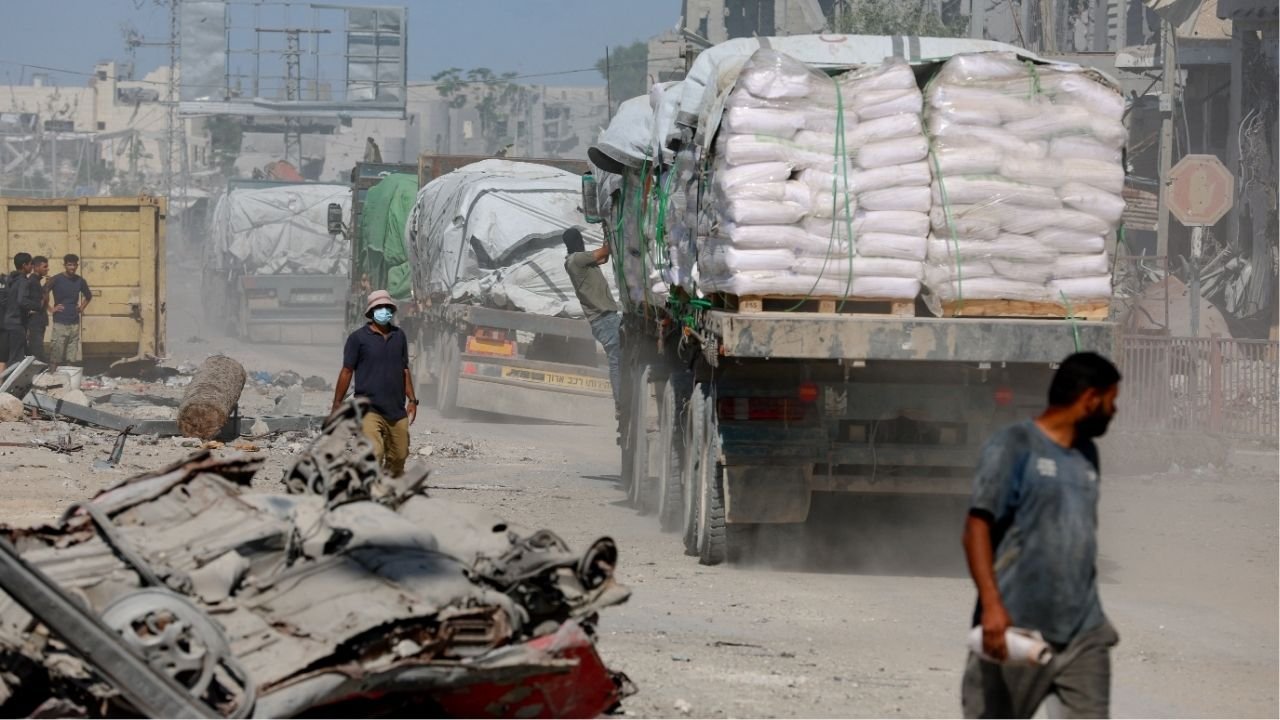
Despite a declared ceasefire and global pledges to accelerate humanitarian support, aid organizations say large-scale relief deliveries to Gaza have not yet materialized.
The International Committee of the Red Cross (ICRC) and several United Nations agencies reported Tuesday that shipments remain far below what’s needed to address widespread hunger and displacement after nearly two years of war.
Border Closures Stall Humanitarian Access
Israeli authorities have warned that aid flows could slow further as the Rafah border crossing with Egypt — a crucial entry point for southern Gaza — remains closed.
Three Israeli officials told reporters that the government has delayed reopening Rafah at least through Wednesday, citing Hamas’s slow return of the bodies of Israeli hostages killed during the conflict. Hamas officials have said that many burial sites are still buried under rubble, making recovery efforts difficult.
“We need all crossings open,” said UNICEF spokesperson Ricardo Pires. “The longer Rafah stays closed, the more suffering prolongs for people in Gaza, especially those displaced in the south.”
Limited Aid, Rising Needs
Although Israel’s coordination agency COGAT previously said around 600 trucks per day would be allowed during the ceasefire, U.N. monitors say only a fraction of that number has entered.
Aid continues to move mostly through the Kissufim crossing in central Gaza, while northern areas — where tens of thousands of people are returning — remain largely cut off.
“The shift has not yet happened,” said Christian Cardon, ICRC spokesperson. “We are still seeing only a few trucks coming in, with large crowds surrounding them — conditions that don’t meet humanitarian standards.”
The World Food Programme (WFP) confirmed that it brought in 137 trucks since the weekend, but none on Monday due to the hostage-prisoner exchange. It estimates that up to 400,000 people in Gaza City have gone without aid for several weeks.
UNICEF said it has managed to deliver limited shipments of family tents, winter clothing, tarps, and hygiene kits, while hoping for a broader scale-up “later this week.”
Restrictions and Delays for Relief Groups
Roughly 50 international aid organizations, including CARE, Oxfam, and the Norwegian Refugee Council, are still waiting for clearance to move their supplies into Gaza. Bureaucratic restrictions and registration barriers continue to stall their efforts.
“We’re in this limbo,” said Bushra Khalidi, policy adviser for Oxfam. “The needs of a population that has experienced famine for months are not going to be met with a few trucks.”
Some organizations have received partial approval. Catholic Relief Services confirmed it has been allowed to bring in limited shipments, prioritizing shelter materials for displaced families.
Humanitarian Outlook
International monitors warn that the continued delay in scaling up aid could deepen the crisis in Gaza, where global hunger trackers say hundreds of thousands are at risk of famine.
Relief leaders are urging all parties to open additional crossings and allow unrestricted access for humanitarian supplies to reach the enclave’s most affected areas.


